


Wooden Furniture Buying Guide 2026: Types of Wood, Quality Checks & What to Know Before You Buy
Buying wooden furniture is a long-term investment. Whether you're choosing a bed, wardrobe, dining table, TV unit or sofa frame, the type of wood and the quality of construction can make a significant difference to its durability, appearance and maintenance.
But here's where many buyers get confused.
Is solid wood always better? Is engineered wood a poor choice? What is the difference between teak, sheesham, plywood and MDF? And how can you identify good-quality wooden furniture in a showroom?
At Febonic Living, we believe informed furniture decisions begin with understanding what's inside the product—not just how it looks from the outside.
In this guide, we'll explain the main types of wood, their advantages and limitations, and the important things to check before buying wooden furniture for your home in India.
1. Why Understanding Wood Quality Matters


Two pieces of furniture may look almost identical but perform very differently over time.
The difference can come from:
-
The type and grade of wood used
-
The moisture content of the material
-
The strength of joints and connections
-
The quality of the internal structure
-
The finish and protective coating
-
The conditions in which the furniture is used
Good furniture is not defined by wood type alone. Material quality, construction, design and maintenance all matter.
2. Understanding the Main Types of Wood Used in Furniture
Before buying wooden furniture, understand the difference between natural solid wood and engineered wood products.
A. Solid Wood


Solid wood is made from natural timber rather than manufactured wood fibres or layers bonded together.
Common examples include teak and sheesham.
Advantages
-
Natural grain patterns and character
-
Can be refinished, depending on the finish and condition
-
Strong and durable when properly selected and constructed
-
Often develops an attractive appearance with age
Things to consider
-
Usually costs more than many engineered alternatives
-
Can expand, contract or develop cracks as moisture conditions change
-
Quality varies by species, timber grade, drying and construction
-
Requires appropriate care to protect its finish
Best suited for: Dining tables, selected bed frames, chairs, cabinets and statement furniture.
B. Engineered Wood
Engineered wood is manufactured by bonding wood fibres, particles or veneers together. Different products have different strengths and uses.


The three common categories are:
|
Material |
What it is |
Common uses |
|---|---|---|
|
Plywood |
Thin wood veneers bonded in layers |
Cabinets, furniture panels, selected structural components |
|
MDF |
Fine wood fibres bonded under pressure |
Painted panels, decorative doors, smooth surfaces |
|
Particleboard |
Wood particles bonded together |
Budget furniture, shelves and panels |
Important: Engineered wood is not automatically low quality. A suitable grade, appropriate thickness, good edge protection and well-designed construction can provide excellent value.
However, moisture resistance varies by product. Ordinary MDF and particleboard should not be assumed to be waterproof.
3. Types of Natural Wood: Which Is Better?


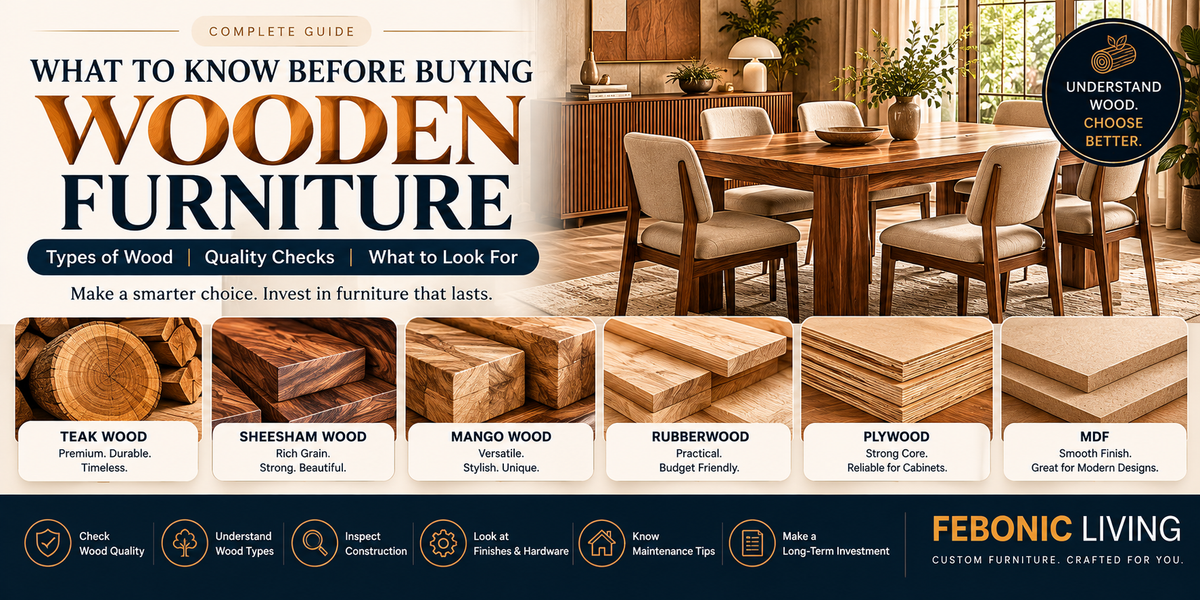
Teak Wood
Teak is valued for its natural oils, dimensional stability and resistance to many forms of weathering when appropriately used.
Advantages: Attractive grain, durability and good natural resistance to moisture-related deterioration compared with many untreated woods.
Limitations: Often expensive; quality and authenticity should be verified.
Best for: Premium furniture, dining tables, outdoor furniture designed for suitable conditions, and selected bed frames.
Sheesham Wood (Indian Rosewood)
Sheesham is popular in Indian furniture for its distinctive grain and rich brown tones.
Advantages: Attractive natural patterns, good strength for many furniture applications, and a substantial appearance.
Limitations: Quality depends on timber selection, seasoning and construction; it still needs protection from excessive moisture and heat.
Best for: Dining furniture, cabinets, beds and traditional or contemporary solid-wood furniture.
Mango Wood
Mango wood is used in a variety of furniture styles, particularly decorative and contemporary designs.
Advantages: Distinctive grain, varied natural tones and attractive finishes.
Limitations: Properties vary with timber quality and preparation, so construction and drying remain important.
Best for: Dining tables, cabinets, sideboards and accent furniture.
Rubberwood
Rubberwood is a plantation-grown timber commonly used for indoor furniture.
Advantages: Useful for furniture components, a relatively consistent appearance and often a more accessible price than premium hardwoods.
Limitations: Needs appropriate treatment and protection against moisture and biological deterioration.
Best for: Dining chairs, tables, bed components and indoor furniture.
Which should you choose? There is no single winner for every product. Teak, sheesham, mango wood and rubberwood differ in price, appearance and properties. The right choice depends on the furniture's purpose, construction and budget.
4. Solid Wood vs Plywood vs MDF: Which Is Best?
|
Factor |
Solid wood |
Plywood |
MDF |
|---|---|---|---|
|
Natural wood appearance |
Excellent |
Depends on surface veneer or finish |
Usually requires a finish or veneer |
|
Structural use |
Depends on design and species |
Often suitable when correctly specified |
More suitable for appropriate panel applications |
|
Moisture behaviour |
Can move with humidity |
Depends on grade, glue and edge protection |
Standard MDF is vulnerable to moisture |
|
Surface finishing |
Can be stained or refinished |
Depends on veneer and surface |
Excellent for smooth painted finishes |
|
Typical cost |
Often higher |
Varies by grade |
Often economical for panels |
|
Common uses |
Tables, frames, cabinets |
Cabinets, panels and selected structural parts |
Decorative panels, doors and painted furniture |
One important point: the best furniture may use more than one material. For example, a product may combine a solid-wood frame, plywood panels and MDF decorative components. What matters is whether each material is appropriate for its job and clearly represented to the buyer.
5. How to Check Wooden Furniture Quality in a Showroom


A polished surface can hide differences in internal construction. Before buying, check the following.
1. Ask Exactly What Material Is Used
Do not settle for descriptions such as "premium wood" or "wooden finish."
Ask:
-
Is it solid wood, plywood, MDF or particleboard?
-
Which components use each material?
-
Is the surface a natural veneer, laminate or printed finish?
-
What thickness and grade are used where relevant?
Get important specifications in writing.
2. Inspect the Edges and Underside
Look at areas that are not immediately visible.
Check whether:
-
Edges are neatly finished
-
Panels are aligned correctly
-
There are gaps, chips or exposed core material
-
The underside looks properly assembled
-
The finish is consistent across visible surfaces
An unfinished underside is not automatically a defect, but poor assembly or exposed vulnerable edges deserve attention.
3. Check the Joints
Joints often reveal more about construction than the surface finish.
Look for:
-
Gaps between joined components
-
Loose or poorly aligned connections
-
Excessive movement
-
Visible cracking around fasteners
For chairs and tables, check for wobbling. For beds, ask how the side rails, centre supports and headboard are connected.
4. Check Stability
Gently test the furniture as intended.
A table should stand level. A chair should not wobble excessively. A bed frame should feel stable when assembled correctly.
Do not rely on weight alone as a quality indicator.
5. Inspect the Finish
Look for:
-
Uneven colour
-
Rough patches
-
Bubbling or peeling
-
Sharp edges
-
Poorly finished corners
A quality finish should suit the intended use and provide appropriate protection.
6. Ask About Seasoning and Moisture
Timber that has not been adequately dried may shrink, swell, warp or crack as moisture conditions change.
Ask the manufacturer how the timber is dried and prepared. If technical specifications are available, check them rather than relying on appearance alone.
6. What to Check Before Buying a Wooden Bed


A bed needs to support the mattress and its occupants while remaining stable over time.
Before buying, check:
-
Frame material: Confirm which parts are solid wood or engineered wood.
-
Side rails: Ask about their thickness, connections and support.
-
Centre support: Larger beds often need suitable centre rails and legs.
-
Slats or platform: Check the support design and mattress compatibility.
-
Headboard attachment: Ensure it is secure and does not move excessively.
-
Storage mechanism: For storage beds, check the mechanism, hinges and safe operation.
-
Dimensions: Confirm mattress size, external dimensions and room clearance.
What if you prefer upholstered beds?
For upholstered beds, the outer fabric is only one part of the product. Ask about the internal frame, support structure, padding, upholstery maintenance and storage mechanism if applicable.
A well-designed upholstered bed combines the desired look with a stable and suitable internal structure.
7. What to Check Before Buying a Wooden Wardrobe
Wardrobes need to handle repeated opening, closing and storage loads.
Pay attention to:
-
Panel material and thickness
-
Hinge quality and alignment
-
Drawer runners and smooth operation
-
Shelf support and expected load
-
Edge banding and corner finish
-
Back-panel construction
-
Resistance to moisture in the intended location
For Indian homes, avoid placing ordinary wood-based panels in areas with persistent dampness or direct water exposure unless the material and construction are specifically suitable.
8. What to Check Before Buying a Wooden Dining Table


A dining table experiences regular loading, movement and cleaning.
Check:
-
Whether the top is solid wood, veneer or another panel material
-
How the legs connect to the tabletop
-
Whether the table rocks when gently tested
-
Whether the finish tolerates the recommended cleaning routine
-
Whether the table size suits your dining chairs and room
-
Whether the chair joints and seats feel stable
If you choose a veneer tabletop, that does not automatically mean the table is poor quality. The substrate, veneer quality, edge treatment and construction all matter.
9. How Indian Climate Affects Wooden Furniture
India has varied climates, including humid coastal areas, dry regions and places with significant seasonal changes.
Wood responds to changes in moisture in the surrounding air. Depending on the material and construction, this can cause movement, swelling, shrinkage or cracking.
To protect wooden furniture:
-
Keep it away from persistent dampness and direct water exposure.
-
Avoid placing it in harsh direct sunlight for prolonged periods.
-
Maintain reasonable indoor ventilation.
-
Wipe spills promptly.
-
Use cleaning and polishing products recommended for the finish.
-
Check wall dampness before installing wardrobes or cabinets against walls.
Remember: A higher price or a solid-wood label does not make furniture immune to climate-related movement. Proper drying, construction and maintenance are essential.
10. Common Mistakes to Avoid When Buying Wooden Furniture


Avoid these common mistakes:
Mistake 1: Assuming all wooden furniture is solid wood. Always confirm the actual material used in each major component.
Mistake 2: Choosing based only on appearance. A beautiful finish cannot compensate for unsuitable construction.
Mistake 3: Assuming heavier furniture is always better. Weight alone does not prove material quality or structural strength.
Mistake 4: Ignoring hardware and joints. Hinges, fasteners, drawer runners and connections affect everyday performance.
Mistake 5: Forgetting room measurements. Check doorways, staircases, lifts and installation clearance before ordering.
Mistake 6: Not checking warranty terms. Ask what is covered, for how long, and whether the warranty includes structural components, hardware or finish defects.
Mistake 7: Ignoring maintenance requirements. Different materials and finishes need different levels of care.
11. Is Expensive Wooden Furniture Always Better?
Not necessarily.
Higher prices can reflect better timber, craftsmanship, design, hardware, finishing or brand positioning. But price alone does not guarantee quality.
A well-constructed engineered-wood cabinet may be a better choice for your needs than an unsuitable solid-wood alternative. Similarly, solid wood may be worth the investment for a dining table that you want to keep and refinish for many years.
Evaluate furniture based on:
-
Material transparency
-
Construction quality
-
Intended use
-
Finish and hardware
-
Warranty and service
-
Maintenance requirements
-
Overall value for money
The goal is not to buy the most expensive furniture. It is to buy furniture that suits your home and is built for its intended purpose.
12. Wooden Furniture Buying Checklist
Use this checklist when visiting a furniture showroom.
Showroom inspection checklist
0 of 9
Why Choose Febonic Living?
At Febonic Living, we believe choosing furniture should be about more than selecting a design. It should be about understanding materials, comfort, construction and how the product fits your home.
Whether you're planning an upholstered bed, a comfortable sofa or furniture for a complete room, take the time to understand the materials and customization options available.
Our goal is to help you make informed decisions that balance aesthetics, functionality and long-term value.
Make a Smarter Furniture Choice with Febonic Living
Choose furniture based on what matters most: quality, comfort, design and suitability for your home.
Explore our furniture collections, discuss your customization requirements and visit the Febonic Living Experience Centre to see furniture in person.



Leave a comment
This site is protected by hCaptcha and the hCaptcha Privacy Policy and Terms of Service apply.